Strategic HR Integration
Strategic HR Integration Toolkit for Leaders
Evidence & Resources
Strong evidence is the backbone of strategic HR. Across organisations, the same structural elements appear repeatedly. Where performance management truly delivers, it is built on clear, repeatable principles — not guesswork. This page collects top-tier evidence-based strategic HR integration model research to help leaders make decisions confidently, build business cases, implement practices that actually work, and continuously improve HR outcomes.
Strategic HR Integration
Strategic HR Integration Toolkit for Leaders
Evidence & Resources
Strong evidence is the backbone of strategic HR. Across organisations, the same structural elements appear repeatedly. Where performance management truly delivers, it is built on clear, repeatable principles — not guesswork. This page collects top-tier evidence-based strategic HR integration model research to help leaders make decisions confidently, build business cases, implement practices that actually work, and continuously improve HR outcomes.
Here you’ll find a curated set of credible sources — each clearly labelled with what it’s useful for — so you can quickly back up decisions, build a strong business case, and choose practices that are supported by evidence (not opinion).
1
What it covers: A V4 (Czechia–Hungary–Poland–Slovakia) overview of HR systems and practices across the full “HR operating model” — HR role/strategy/workforce planning, job structure, recruitment, training/onboarding, talent management, evaluation (incl. appraisal), health & safety, pay/benefits, HR self-service/HRIS, HR controlling, and HR outsourcing.
Why it’s worth a leader’s time: A practical regional benchmark of how HR is actually organised and run in V4 organisations, helping you spot gaps, compare options, and prioritise improvements that better support organisational aims (strategic and operational).
2
What it covers: The foundational Harvard HR Model introducing the 4Cs framework for monitoring whether HR practices produce the people outcomes required for strategy execution: commitment (engagement, loyalty, motivation), competence (skills and readiness), congruence (values and behaviour alignment), and cost-effectiveness (value vs. cost).
Why it’s worth a leader’s time: It provides a clear, measurable framework that moves beyond activity-based HR (“we ran 50 training sessions”) to outcome-based HR (“are people more capable, committed, and aligned?”). This is the bridge between HR action and business results – still highly relevant 40+ years later. Part of the evidence-based strategic HR integration model research.
3
What it covers: Dave Ulrich’s seminal work defining the HR Business Partner model and explaining why HR needs a seat at the strategic table – not just as an implementer, but as a shaper of capability and organisational readiness. Introduces the four HR roles: Strategic Partner, Change Agent, Administrative Expert, and Employee Champion.
Why it’s worth a leader’s time: It helps you reposition HR from a support function to a strategic enabler. If you want HR to contribute to competitive advantage (not just compliance), this body of work shows what that looks like in practice – and what needs to change in HR’s role, competencies, and operating model.
4
What it covers: Robert Kaplan and David Norton’s framework for connecting strategy to measurable outcomes across four perspectives: financial, customer, internal process, and learning & growth. Provides a structured way to link HR activity → people outcomes → organisational outcomes, so leadership can make better decisions.
Why it’s worth a leader’s time: It gives you a credible way to demonstrate HR’s impact on business results. Instead of generic engagement scores, you can show how people’s outcomes drive productivity, innovation, retention, and profitability – measured and tracked over time. The logic translates HR contribution into the language executives understand.
5
What it covers: Bowen and Ostroff’s influential research showing that HR systems only create impact when leadership legitimises them, resources them, and managers implement them consistently. Introduces the concept of “HR system strength” – the clarity, consistency, and consensus around HR practices that determine whether they actually work.
Why it’s worth a leader’s time: Even the best-designed HR system fails without leadership buy-in and manager capability. This research explains why – and what to do about it. It shifts the focus from “what HR designed” to “what line managers actually do” and “what employees experience.” Essential reading for understanding implementation barriers.
6
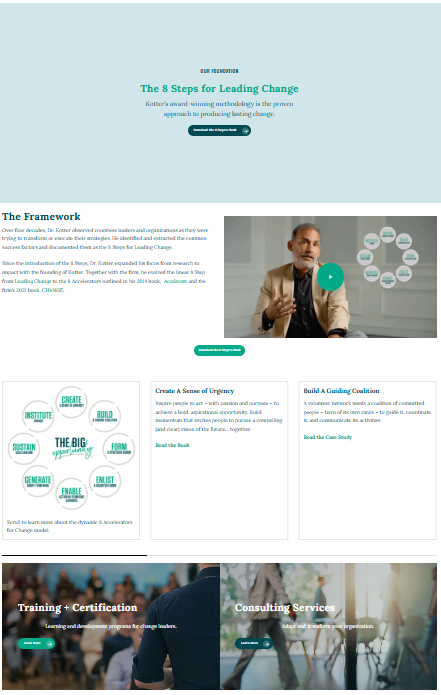
What it covers: John Kotter’s evidence-based change management framework showing that successful implementation starts with a clear trigger, credible framing, and practical involvement of stakeholders. The 8 steps cover creating urgency, building coalitions, forming vision, communicating, empowering action, generating short-term wins, consolidating gains, and anchoring change in culture.
Why it’s worth a leader’s time:Most HR initiatives fail not because the model is wrong, but because change management was weak. This research gives you a practical playbook for creating urgency, building coalitions, communicating vision, and embedding new practices – grounded in decades of evidence across industries. Makes change adoption predictable rather than accidental.
7
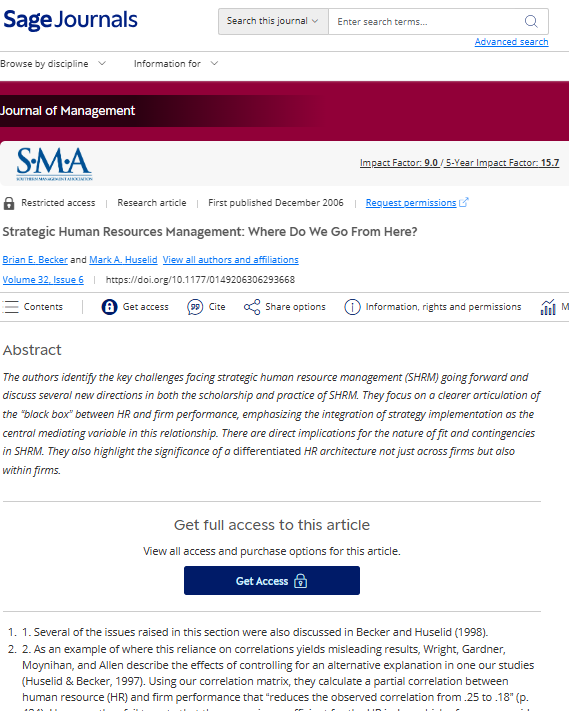
What it covers: Becker and Huselid’s comprehensive review of two decades of strategic HRM research, examining what works, what doesn’t, and where the field needs to go. Covers the evolution from best practices to best fit, the role of HR architecture, workforce differentiation, and the critical importance of implementation quality and leadership commitment.
Why it’s worth a leader’s time: It provides a rigorous, evidence-based synthesis of what actually drives HR’s impact on business performance – cutting through fads and focusing on what the research consistently shows. Perfect for building a credible business case and avoiding common implementation mistakes. Includes practical frameworks for workforce strategy and HR measurement.
8
What it covers: Wright and McMahan’s foundational paper defining strategic HRM and explaining the logic of vertical integration (HR priorities match business strategy), horizontal integration (HR practices reinforce each other), and the theoretical underpinnings of why integration matters for performance.
Why it’s worth a leader’s time:This is the foundational logic of strategic HRM. It explains why isolated HR initiatives (e.g., “let’s improve onboarding”) rarely create lasting value – and why integrated systems do. Essential for understanding what makes HR strategic versus merely operational, with clear frameworks you can apply immediately.
Explore the next part of the Toolkit:
Business Impact
Learn how strategic HR integration turns people priorities into strategy execution, measurable impact and faster...
See next partThe framework
A practical strategic HR alignment cycle step-by-step framework that connects business strategy, HR systems and...
See next partYour Maturity Check
Strategic HR alignment maturity self-assessment checklist to quickly evaluate your organisation and choose the right...
See next partImplementation Playbook
12-month strategic HR integration implementation playbook helps align HR, implement strategy, and improve organisational results.
See next partEvidence & Resources
Evidence-based strategic HR integration model research to guide leaders, back decisions with data, and implement...
See next part

SUBSCRIBE TO OUR NEWSLETTER!
Join the HR professional community of the V4 region!
Evidence-based HR solutions, proven best practices and professional events – exclusively for subscribers. Access the latest research insights, practical tools, case studies and invitations addressing current challenges and innovative solutions in human resource management, directly from the project’s expert network.
