
Everyone Is Excellent.
Yet the System Still Doesn’t Work.
Annual Review Rituals, Forgotten Goals and Disengaged Managers: Why Most Performance Management Systems Fail – and How They Can Become Real Decision-Support, People-Centred Tools
The Problem Everyone Knows About but Nobody Talks About
Ask any HR leader in a large organisation about their performance management system and the answer usually sounds something like this: it exists, it works, but nobody really likes it.
Research covering more than two thousand organisations across the V4 region paints an even clearer picture: nearly forty percent of surveyed companies have no systematic performance management process at all, and even where systems exist, annual appraisal rituals still dominate — despite the fact that most mature organisations declared this approach outdated years ago.
This is not merely an HR methodology issue. What the research reveals is business loss: there are no real mechanisms for tracking objectives, feedback cycles are too slow, and top performers often leave quietly. In large organisations, where strategy execution depends on thousands of daily decisions and interactions, the absence or dysfunction of performance management is not an HR problem — it is a competitiveness issue.
The V4 Region’s Gap: Not Opinion, but Data
Comparative research suggests that performance management maturity across the Visegrad region lags approximately fifteen to twenty years behind Western European practice. While Dutch, German and British corporations increasingly build real-time performance platforms, predictive analytics capabilities and continuous feedback cultures, many Central European companies still struggle with completing mandatory annual review forms.
The numbers speak for themselves: only twenty-nine percent of companies in the V4 region integrate operational and strategic performance management tools. In approximately seventy percent of organisations, performance management primarily serves as justification for compensation decisions — rather than supporting development, succession planning or strategic workforce planning. As a result, the system ends where it started: an administrative ritual everyone wants to complete and few take seriously.
Why Does Annual Appraisal Lie?
Annual performance reviews remain one of the most persistent dysfunctions within corporate HR. The underlying logic appears simple: goals are set at the beginning of the year and evaluated at the end. In practice, however, this simplicity creates the problem. Months pass between performance and evaluation, memories fade, context disappears and feedback loses its developmental value.
A global IT company case study demonstrates this dynamic clearly: within traditional score-based systems, teams spent hours debating in calibration meetings whether someone deserved a three or a four — while hardly anyone discussed actual contribution or future development needs.The result was nearly always identical: everyone was rated good or excellent. Ratings reflected compensation intentions rather than actual performance, while labour costs became increasingly difficult to control.
“We spent too much time debating whether someone deserved a three or a four — while the system itself never became fairer, only louder.”
The Four Pillars: What Makes a Performance System Work?
Research findings and large corporate case studies suggest that effective performance management rests on four mutually reinforcing pillars. This is not about replacing annual reviews with something entirely different. It is about changing the logic itself: shifting from evaluation to development, from backward-looking discussions to forward-looking conversations, and from administration to meaningful dialogue.
1. Continuous Feedback Culture
Development conversations should be embedded into the natural rhythm of work. Managers stop acting as annual judges and become ongoing coaches: celebrating successes when they happen, addressing issues before they escalate and regularly asking employees what they need to improve.
2. Strategic Goal Alignment Through OKRs
Objectives and Key Results (OKRs) are not simply goal-setting tools. They create visible connections between everyday work and organisational priorities. A financial analyst, for example, becomes more engaged when understanding how their reports influence organisational cost structures and competitiveness.
3. Multi-Dimensional Evaluation
Real performance cannot be reduced to a single number.
Meaningful evaluation includes at least four dimensions:
- business results achieved,
- demonstrated behaviours,
- competencies developed,
- quality of collaboration.
Used selectively and purposefully, 360-degree feedback also helps leaders recognise their own limitations instead of evaluating employees exclusively from above.
4. Development-Focused Thinking
Performance conversations should not represent closure — they should create openings. Individual development plans should function as living documents connecting performance outcomes with career ambitions and concrete actions.
The Illusion of Fairness: When Equal Distribution Becomes Unfair
One of the most conflict-generating aspects of performance management is compensation differentiation. Across large organisations in the V4 region, managers frequently default to equal distribution: everyone receives something, nobody is left out entirely and difficult conversations are avoided. This feels comfortable in the short term but simultaneously damages compensation effectiveness and performance culture.
In one global IT company example, the solution relied on a simple but firm rule: approximately eighty percent of employees could receive salary increases, while twenty percent would not. This was not punishment — it created differentiation.
If average increases were five percent:
- top performers received ten percent,
- consistently strong performers received five percent,
- employees meeting minimum expectations received two to three percent.
The framework created boundaries, but managers remained accountable for decisions.
As one principle illustrates:
“When everyone receives a small increase, two things happen simultaneously: the budget disappears and the performance message disappears with it.”
Strategic Alignment: How Individual Goals Become Organisational Performance
One of the most critical — and frequently neglected — questions is whether individual performance goals truly connect to organisational priorities. Fewer than half of organisations in the V4 region have documented HR strategies, and even where strategies exist, integration with performance management is often weak. People work hard — but not necessarily on the right priorities.
Effective strategic alignment works in both directions. From top to bottom, organisational priorities such as cost optimisation, digitalisation or sustainability translate into team objectives and individual commitments. From bottom to top, performance conversations surface operational insights and development needs that influence strategic decision-making. Without this two-way connection, strategy exists on paper but rarely shapes everyday behaviour.
The Manager as Coach: The Real Key Player
The strongest predictor of performance management success or failure is not software, templates or HR processes. It is the direct manager’s ability and willingness to conduct meaningful performance conversations. Research sends a clear message: leadership capability is one of the strongest predictors of system effectiveness.
This remains especially challenging across Central Europe. Many leadership cultures still operate through directive logic: instruct, evaluate, decide. Coaching cultures require something different: questioning, developing and creating opportunities.
The best organisations therefore do not simply provide templates — they build leadership capability through structured programmes focused on:
- asking effective questions,
- delivering developmental feedback,
- managing difficult performance conversations.
AI and HR Digitalisation: Without Data There Are No Decisions
Performance management systems across the V4 region remain significantly less digitalised than those in Western Europe. Only twenty-six percent of companies use self-service HR information systems. This is not merely a convenience issue. Integrated digital platforms are fundamental if performance data is expected to support decisions rather than simply document processes.
Artificial intelligence may significantly transform two areas. The first is predictive analytics: AI tools can forecast turnover risk, identify high-potential talent and suggest development priorities based on historical data. The second is process augmentation: OKR breakdowns, feedback reminders and performance trend visualisations are all areas where AI can reduce managerial administration and create more space for human conversations.
Maturity Levels and Typical Traps: Where Are V4 Corporations Today?
Performance management maturity is not binary. Between fragmented, project-based attempts and integrated, data-driven systems aligned with strategy lies a long development journey — and many large organisations in the V4 region remain somewhere in the middle. Corporate frameworks may appear mature globally, but local implementation is often inconsistent: goals exist on paper, feedback cultures are weak, systems ultimately serve compensation administration rather than performance improvement.
Common traps remain predictable: reducing conversations to rating scales, automatic salary increase reflexes, development plans that are forgotten after completion, declining attention after implementation. The most successful organisations do not merely avoid these traps — they actively monitor and manage them.
Strategic Conclusion: Performance Management as Competitive Advantage
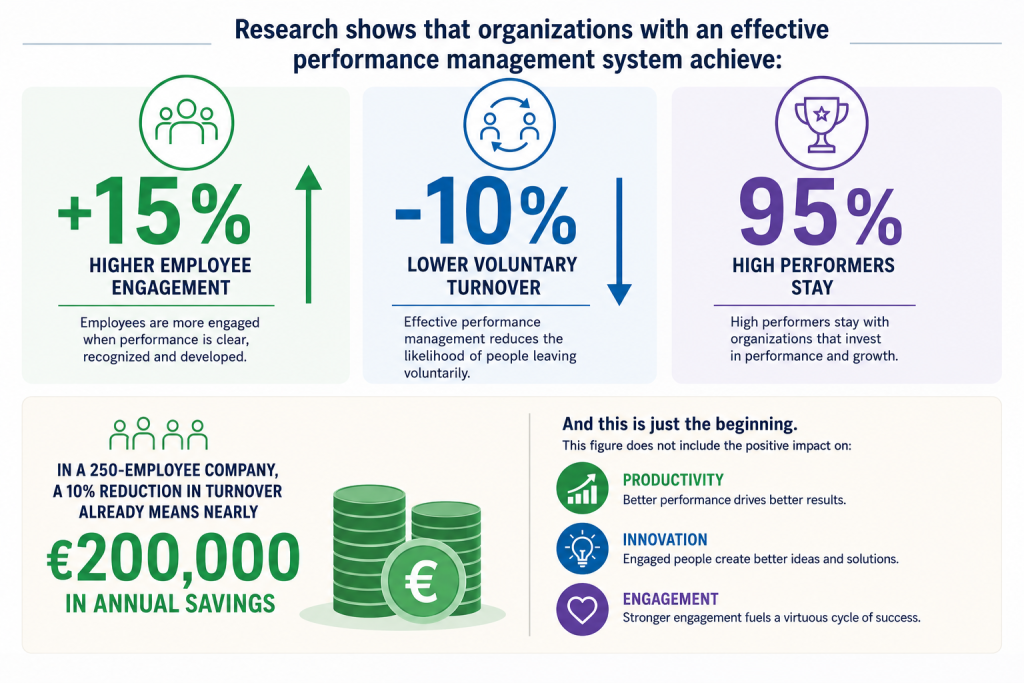
Large Central European organisations that take performance management seriously gain measurable competitive advantages. Research indicates that organisations with effective systems experience: fifteen percent higher employee engagement, ten percent lower voluntary turnover, retention rates of ninety-five percent among top performers. In a company with 250 employees, reducing turnover by just ten percent may already create annual savings approaching €200,000 — before accounting for productivity, innovation and engagement effects.
Yet ultimately, performance management is not about numbers. It is about whether organisations can answer three simple questions: Does everyone understand what is expected of them?
Do employees receive regular developmental feedback?
Can people see how their work connects to organisational goals? Where the answer is yes to all three, organisations do not merely have systems. They have performance cultures. And that is what top talent looks for when choosing employers.

Subscribe to our newsletter!
Join the HR professional community of the V4 region!
Evidence-based HR solutions, proven best practices and professional events – exclusively for subscribers. Access the latest research insights, practical tools, case studies and invitations addressing current challenges and innovative solutions in human resource management, directly from the project’s expert network.